Thursday, February 25, 2010

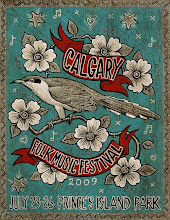
Extended programming Friday July 23!

The Folk Festival gives you permission to call in sick Friday July 23.

How else will you enjoy our extended daytime programming, with three stages presenting concerts and sessions from 3:00 pm - 6:00 pm? That adds up to 9 hours of additional programming!

We know many of you are already at the festival Friday afternoon patiently waiting for the gates to open, so wait no longer!

Friday, February 12, 2010

CBC Radio 3 Searchlight: The Best Music Festival in Canada

The Calgary Folk Music Festival has been nominated in CBC Radio 3's Searchlight competition. Now music fans from across the country will determine which fest is the best. Voting takes place at radio3.cbc.ca by clicking on the searchlight promo.


Three years ago, the Globe and Mail declared the Calgary Folk Music Festival to be ‘one of the seven musical wonders of the world.’ A nod from CBC Radio 3 would be the icing on our kudos cake.


And why might we be among the finest festivals in Canada, perhaps even THE BEST? It could be due to the setting: Prince’s Island Park, a forested retreat nestled downtown which houses our 7 stages, family area, beer garden and arts and food markets. You can’t beat the ambiance, setting and array of offerings at Calgary’s annual musical antidote to Stampede mayhem.


Or maybe it’s the cool, relaxed vibe. Here, hippies and CEOs co-exist; the audience ranges from babies to seniors. We’ve been called the loosest and tightest festival, thanks to our organization, great recycling program and contributions of our 1500 community volunteers. It's a safe haven where the usual laws of order, decorum and fashion are temporarily suspended for the weekend.


But of course, it’s really about the music. It has been said that the Calgary Folk Music Festival has the best programming of any of the post-folk music fests; a genre-bending program that cleverly combines roots, world and indie artists from around the globe. It’s the city’s largest annual gathering of original, independent artists. From influential artists who began making music in the ‘60s to innovative artists whose music was created in the last decade, the Festival is a wonderful journey into the heart and soul of the roots and evolution of the music we like to call folk.


Ever-evolving programming pairs musicians in magical collaborations where one-time ensembles are created as artists trade songs and back each other up. Where else can you find Dick Gaughan jamming with Arrested Development, Jason Wilson and Mutabaruka?


Make the 31st annual Calgary Folk Music Festival the soundtrack to your summer, and vote for us every day at radio3.cbc.ca.

Monday, February 8, 2010

The secret of the Canadian folk festival: Chumbawamba-style


The Canadian Folk Festival - it's a closed secret. What happens over there
doesn't seem to happen anywhere else on the planet, but all the British
musicians who make the trip over there and play these things don't ever say
anything once they get back. Shhh! Canada? Folk Festival? Don't know what
you're on about, mate.

It's like the Freemasons. You meet someone who's played at one and suddenly
you're all fancy handshakes and nods and winks. Oh yes, ha ha, how weird and
freaky. But between ourselves, let's keep it quiet, eh?

Here's the big secret (what a blabbermouth. Half a lager and a cocktail with
an umbrella in it and I'll tell you anything). You go to Canada and play one
of the Folk Festivals. You may or may not get the chance to play on the main
stage (and to be honest, the main stage is an irrelevance there). You're
given an itinerary that tells you that you'll be doing four workshops over
the weekend, at any given time of day, sharing a stage with any given type
of act/musician/band. It's like opening Xmas presents. Ooh, what've we got?
It's exciting and weird and interesting.

Canadian festivals open their gates at some unearthly hour of the morning,
and hundreds - no, many thousands - of people pile through the gap armed
with folding chairs and rucksacks full of sandwiches. At one such festival
last year we were told that this morning rush was called (after the
preferred choice of footwear) 'The Birkenstock Dash'.

Those few hundred who get to the main stage first set up their chairs and
their little rugs and blankets, do their territorial pissing, and then
wander off to find coffee. The chairs and blankets stay put, ensuring that
the space is reserved for the time seven hours later when some ageing old
folkie strums his/her way through a couple of old hits as the evening's
finale.

Thus, the main stage audience is claimed and staked out first thing. The
only thing to do is see what's going on on the other stages. There are
usually four, five, six other stages. Here's where the interesting stuff
goes on. No Birkenstock 'claim your patch' bollocks here. Turn up and watch.
Elbow your way to the front, like at a proper gig.

The Canadian organisers call them 'workshops'. That implies teaching, or
demonstrating, or something. In reality they're loose gatherings of several
musicians, stick 'em on a stage together and see what they come up with. And
call it 'a workshop'.

Now anyone that knows Chumbawamba will know that we're not Grateful Dead or
Phish or any of those jamming bands. In fact, we are officially the
anti-jamming band. We don't jam. We meet. We don't play loosely together,
hoping for musical inspiration. We meet. We don't cruise the old twelve-bar
looking for inspiration. We meet.

We meet and discuss what we should sing about, and how, and why, and in what
form. It makes everyone's life simpler and clearer. It's verbal and open,
not hidden behind fretwork and foot-tapping and fancy musicianship. That's
how we see it, anyway.

So the idea of this band sharing music with other bands on stage at these
Canadian Festivals could be seen as the ultimate horror. But no! Because,
despite our aversion to jamming/noodling/communicating with the musical
muse, we love a challenge. Love being thrown in at the deep end. Swim,
y'buggers!

And this is what the Canadian Festival has taught us - get up there, and
make it work. There's an audience. Yes, we know it's 11 o'clock in the
morning. But the audience want to be entertained. Now! Fear and thrill all
rolled into one.

Over the past few years we've been up onstage playing with Scottish trad
fiddlers, fey singer-songwriters, African dancebands, the lot. This year at
Edmonton we were pitched right in with Arrested Development, fantastic
Atlanta rap group, great tunes, amazing history, great politics. But a
hip-hop group nonetheless, and how do we fit in with that? We shared a stage
for an hour. We played our songs, laughed together, sang 'Enough is Enough'
and kept the rhythm and chords going as Speech from Arrested Development
rapped over the top. We joined in with them, they joined in with us. We
marvelled at the ass-shaking women on stage (don't cry 'sexist!', we all
love to see a woman shaking her behind), they laughed at our ridiculous
Englishness, and we all met somewhere in the middle . somewhere that's
friendly and funny and political and audience-friendly and entertaining.

And half-way through the show I caught myself thinking, 'this wouldn't
happen this easily anywhere else in the world.'

I recently saw Tinariwen and Tunng playing in Leeds. Two different cultures
meeting in the middle. It was brilliant. And I thought then, as I think now,
this is what happens on stage at all those strange and obscure and massive
and amazing Canadian festivals. Every day of the long weekend, on five
different stages. Sometimes it's a disaster. Sometimes it's boring. But it's
always an adventure. Always.

We did other workshops that weekend. One with some bands I can't remember
the name of. One with Oysterband and Dick Gaughan (which, frankly, was too
easy - joining in with Gaughan on 'Diggers Song' and convincing Chopper from
the Oysters up to sing Johnny Cash with us) and one with Mongolian throat
singers Hanggai, which was incredible. Singing one of our acapella songs
along to a throat-sung drone was risky, ridiculous and beautiful, all at the
same time. Joining in with their Chinese drinking song was a joy.

So there you have it. The secret of the Canadian festival. It doesn't seem
to happen anywhere else in the world - the Canadians have their own strange
rules within their own cultural bubble, and I'm happy for them. Happy that
they don't think like we do, that festivals have to be neatly parceled into
genres and styles and boxes. Happy that they don't feel the need to massage
the artist's egos by keeping them well separated from the other acts. Happy
that it forces us musicians into thinking on our feet, working together,
dealing with stuff outside our cosy worlds.
And believe me, the Canadian Festivals are well outside this band's cosy
world. Good. I'm glad. Just don't expect me to buy a pair of Birkenstocks.


Friday, January 29, 2010

A tribute to Kate McGarrigle

Here's some fond remembrances from the Calgary Herald.


'Irreplaceable' folksinger Kate McGarrigle dies

Max Harrold
Canwest News Service; With files from Heath McCoy, Calgary Herald

Wednesday, January 20, 2010

Montreal folksinger and songwriter Kate McGarrigle has died.

The folksinger, famous for her collaboration with her sister Anna, was 63 and had been battling clear-cell carcinoma. She died Monday at home in Montreal surrounded by family members, her brother-in-law Dane Lanken said.

The McGarrigle sisters sang in English and French and played piano, guitar, banjo, and button accordion.

"Sadly, our sweet Kate had to leave us last night," said a statement on the McGarrigle sisters' website. "She departed in a haze of song and love surrounded by family and good friends. She is irreplaceable."

Mike Regenstreif, 55, a music writer and producer of the McGarrigle sisters' tours in the 1970s, described Kate as "one of Canada's greatest singers. It was the sisters' wonderful harmonies that first attracted me to them."

Their sound and style had a closeness that reflected their tight-knit family and it added to their art, he said.

Kerry Clarke, artistic director of the Calgary Folk Music Festival, added her voice to a chorus detailing McGarrigle's impact on the Canadian music scene. "(Kate and Anna McGarrigle) were almost like building blocks of folk music in Canada," Clarke said. "(They were) that crucial. And they're so influential, when you get people like Emmylou Harris covering their songs."

Clarke fondly remembered watching the McGarrigle sisters perform at the Calgary folk fest over the years, noting their quirkiness behind the scenes and the magic of their music onstage.

"(Before their set) it was almost like they were a little bumbling and not quite ready," Clarke said. "They seemed hesitant and a little disorganized. . . . Not quite set up. But then they'd do this amazing, mesmerizing brilliant kind of show. There's nobody like them."

In the 1960s, the sisters were influenced by Bob Dylan and Pete Seger and the McGarrigless gwriting had strong appeal. Over the years the McGarrigles' songs have been recorded by Judy Collins, Marianne Faithful, Emmylou Harris and Nana Mouskouri.

Anna's Heart Like a Wheel was recorded in 1972 by McKendree Spring and, as the title song of an LP, in 1975 by Linda Ronstadt; Anna's Work Song and Kate's Cool River and Lying Song were included on LPs by Maria Muldaur in this same period.

The sisters were awarded the Order of Canada in 1994.

Kate McGarrigle was the mother of singers Rufus Wainwright and Martha Wainwright.

© Calgary Herald 2010

Tuesday, January 5, 2010

Another loss for the folk community

If bad news comes in threes, let's hope Lhasa's is the last remembrance we post for a good long while...

The wonderful artist Lhasa de Sela who mesmerized audiences at folk festivals and other venues across Canada passed away in her Montreal home on January 1, at the age of 37. She succumbed to breast cancer after a twenty-one month long struggle, which she faced with courage and determination.

Throughout this difficult period, she continued to touch the lives of those around her with her characteristic grace, beauty and humor. The strength of her will carried her once again into the recording studio, where she completed her latest album, followed by successful record launches in Montreal at the Théatre Corona and in Paris at the Théatre des Bouffes du Nord. Two concerts in Iceland in May were to be her last.

Lhasa's unusual childhood was marked by long periods of nomadic wandering through Mexico and the U.S., with her parents and sisters in the school bus which was their home. During this period the children improvised, both theatrically and musically, performing for their parents on a nightly basis. Lhasa grew up in a world imbued with artistic discovery, far from conventional culture.

Later Lhasa became the exceptional artist that the world discovered in 1997 with La Llorona, followed by 2003's The Living Road, and 2009's self-titled LHASA. Her unique voice and stage presence, earned her iconic status in many countries throughout the world. She has been described as passionate, sensual, untameable, tender, profound, troubling, enchanting, hypnotic, hushed, powerful, intense, a voice for all time. Lhasa had a unique way of communicating with her public. She dared to open her heart on stage, allowing her audience to experience an intimate connection and communion with her.

An old friend of Lhasa's, Jules Beckman, offered these words:

"We have always heard something ancestral coming through her. She has always spoken from the threshold between the worlds, outside of time. She has always sung of human tragedy and triumph, estrangement and seeking with a witness's wisdom. She has placed her life at the feet of the unseen."

Thursday, December 31, 2009

RIP Vic Chesnutt

The Athens, Georgia singer-songwriter Vic Chesnutt died Christmas Day. He performed at the Calgary Folk Music Festival in 1997, bringing his unique take on songwriting and sense of humour to the rapt audiences. He returned to Calgary in November to perform at Calgary’s Marquee Room.

Paralysed from the waist down following a car accident in 1983, Chesnutt expressed that this tragedy helped to focus his creativity. The sense of humility and wry levity in his songs could only have been born out of tough personal experience that elevated his music far beyond the maudlin.

REM’s Michael Stipe produced his first two albums, 1990's Little and West Of Rome. Chesnutt released over a dozen albums, and was considered at the peak of his abilities. His last couple of Constellation Records’s recordings At The Cut and North Star Deserter highlight raw, powerful, fragile chamber-rock elegies.

Chesnutt was a real songwriter who lived his songs and transformed our sense of what true character, grace and determination are all about. As his good friend Kirstin Hersh wrote: “Vic was brilliant, hilarious and necessary; his songs messages from the ether, uncensored. He developed a guitar style that allowed him to play bass, rhythm and lead in the same song — this with the movement of only two fingers. His fluid timing was inimitable, his poetry untainted by influences.”

Hersh has set up a website to raise money for Vic’s family, to cover his considerable medical bills: http://kristinhersh.cashmusic.org/vic.

While insured, Chesnutt reportedly owed $70,000 in unpaid medical bills and had recently been served with a lawsuit by a Georgia hospital. On the Constellation Records homepage, Jem Cohen, a filmmaker and producer of Chesnutt's North Star Deserter vented his spleen at the United States' "broken health care system depriving so many of the help they need to stay around and stay sane, and a society that never balks at providing more money for more wars but fights tooth and nail against decent care for its citizens. Vic's death, just so you all know, did not come at the end of some cliché downward spiral. He was battling deep depression but also at the peak of his powers, and with the help of friends and family he was in the middle of a desperate search for help. The system failed to provide it."


Friday, November 20, 2009

Community remembers Reverend Ron

Calgary's music community is still in shock following the announcement that Reverend Ron, 20-year host of CJSW's The Blues Witness, passed away Thursday Nov 12, after a battle with cancer.


Ronald J. Predika died the night before CJSW made their long awaited move to the third floor of the MacEwan Student Centre, on the University of Calgary campus. The last song to be played in the old space was Ron's theme song, Merlin Johnson's "Down on Easy Street."

Ron was respected by many and his social circles extended wide and far, said CJSW station manager Chad Saunders.

He kept his illness private. People didn't know much about his background because he didn't think it was necessary -- he wanted to know what your thoughts were now, explained Saunders.

"I can recall blues musicians coming into CJSW," he said. "They were welcomed by Ron as if they had been friends for years -- some were and some he had just met."

Saunders first met Ron after a station meeting when they went for a beer in the Den and sat down at the old picnic tables. When Ron asked the server what was on tap, she replied Labatt's Blue.

"Ron pointed at me and said 'That's for young guys like him, that's not my beer.' The server went through all the beers and Ron had a comment on every single one. It was pretty funny," he recalled.

"Then Ron looked at Don McSwiney [former CJSW station manager] and said, 'Let's talk about CJSW and what makes good radio.' For somebody brand new to the station, that was probably the most informal yet most significant oral history lesson on what it took to make good radio. You knew that as long as Reverend Ron was there, it was going to be alright. He was also our good luck charm when it came to the funding drives. He could get people pumped up."

Over half of CJSW's impressive collection of blues discs have Ron's notes written on them. He had an influential hand in defining that library.

"I don't think that anyone who knew Ron here at the station will forget his programming," mused Saunders. "That will live on forever for sure."

It was Kerry Clarke, now artistic director for the Calgary Folk Music Festival, who put Ron on the air for the first time in 1990.

"I invited him to come on a show Suki Davis and I did as a guest," recalled Clarke. "He brought all kinds of wacky albums, including some Hawaiian ones he found in the garbage. Upon discovering he knew quite a bit about the blues, I asked him to do a few shows. He initially just hosted and I teched. I slowly groomed him into taking over the show, [then called The Blues Experiment.] I remember his first few interviews, where he asked artists things like 'do you have a jukebox?' and 'do you eat jambalaya?' which prompted nervous record reps to suggest that I have Ron ask about their latest album and tour."

During the Calgary Midwinter Blues Festival last February, Ron was inducted into the Calgary Blues Music Association Hall of Fame as a Lifetime Achievement award recipient.

Calgary International Blues Festival co-producer Cindy McLeod said they couldn't imagine a more worthy choice.

"His acceptance speech underscored his humble view that he was 'just a guy spinning records,' but to those of us who love the blues, the Rev will evermore be remembered as the man who brought the best in blues to our radios every week for nearly two decades."

Friends and family are invited to a celebration of Ron's life at Mikey's Juke Joint, 1901 - 10th Avenue S.W., at 12:30 p.m. Sun., Nov. 22. All are invited to stay for the following Sunday open jam.


Image caption: Reverend Ron preaches to the masses at the 2008 International Blues Festival.
Image credit: Ken Clarke / the Gauntlet

From Ken Clarke, The Gauntlet, Thursday, November 19, 2009